Roadside Assistance in Bristol, Connecticut
A small roadside problem can bring your trip to a stop without meaning the vehicle needs to be towed. A dead battery, flat tire, empty fuel tank, or lockout may be something that can be handled on-site when the car is in a safe location and there is enough room to work around it.
Bristol Towing provides roadside assistance throughout the city for common problems that leave drivers temporarily stranded. The approach depends on the issue: a jump-start may help with a discharged battery, a usable spare may solve a flat tire, and fuel delivery or lockout service may be enough to get the trip moving again.
The surroundings matter just as much as the vehicle. A car stopped in a driveway or parking lot is much easier to service than one sitting near traffic on Route 6, Route 72, Route 229, or another busy Bristol road. If the vehicle cannot be handled safely where it sits, or if the problem turns out to involve overheating, steering trouble, wheel damage, or another mechanical issue, towing may be the better next step.
When a Dead Battery Might Only Need a Jump
A vehicle that suddenly refuses to start is often dealing with a battery issue, but there are usually a few warning signs. Slow cranking, repeated clicking, dim interior lights, or complete silence from the starter can all point to a battery that no longer has enough charge.
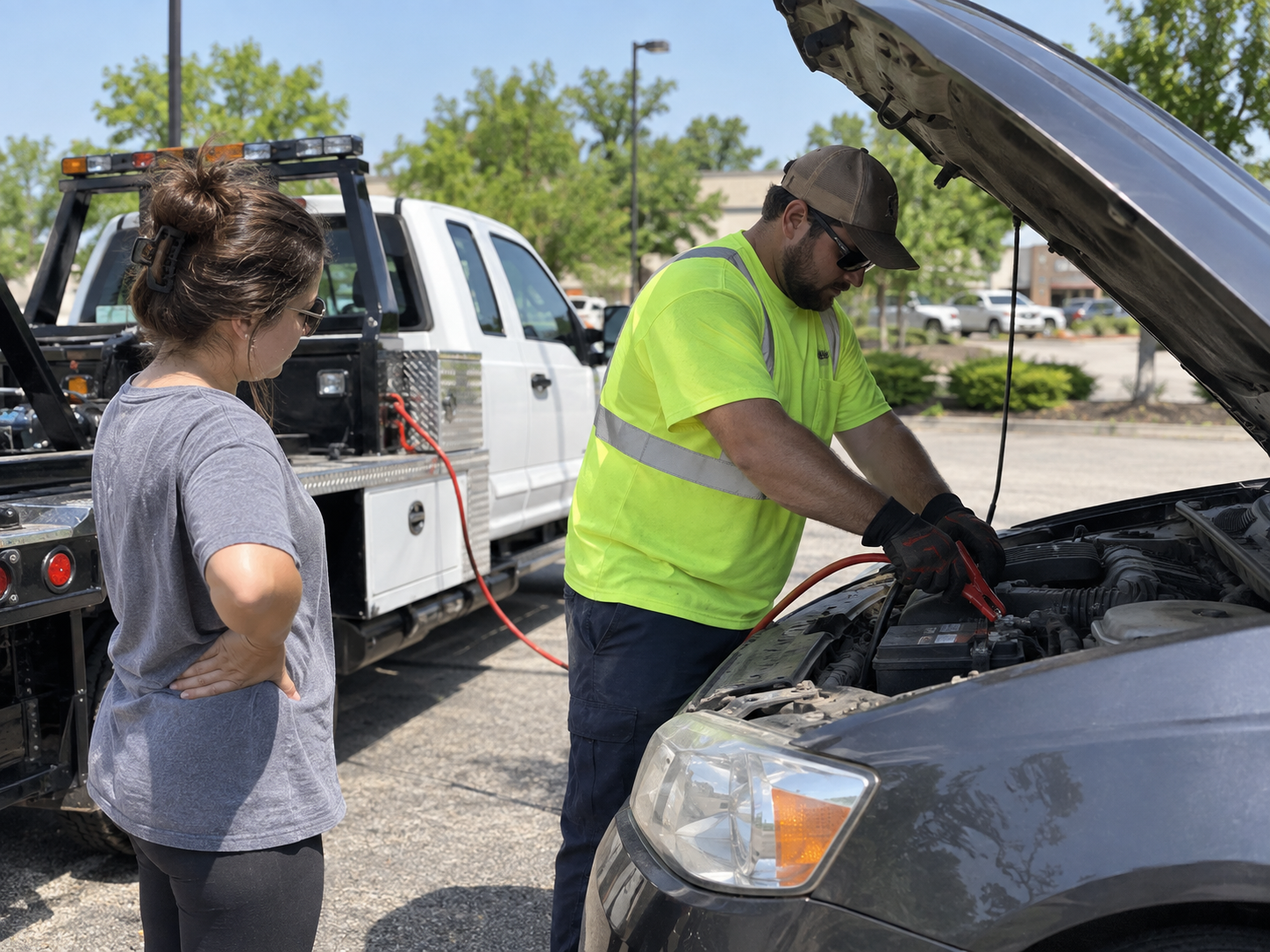
If the battery is simply drained, a jump-start may be enough to get the engine running. Before connecting equipment, it is important to check for obvious problems such as damaged terminals, heavy corrosion, leaking fluid, or anything else that could make a jump unsafe.
Getting the engine started does not necessarily mean the problem is solved. A vehicle that dies again shortly afterward, shows a charging-system warning, or struggles to stay running may have an issue with the battery, alternator, starter, or another electrical component.
When the problem goes beyond a simple loss of charge, towing the vehicle to a repair facility can be the more practical choice. The goal is to get you moving again only when the vehicle is likely to continue the trip safely.
Flat Tire Assistance in Bristol, CT
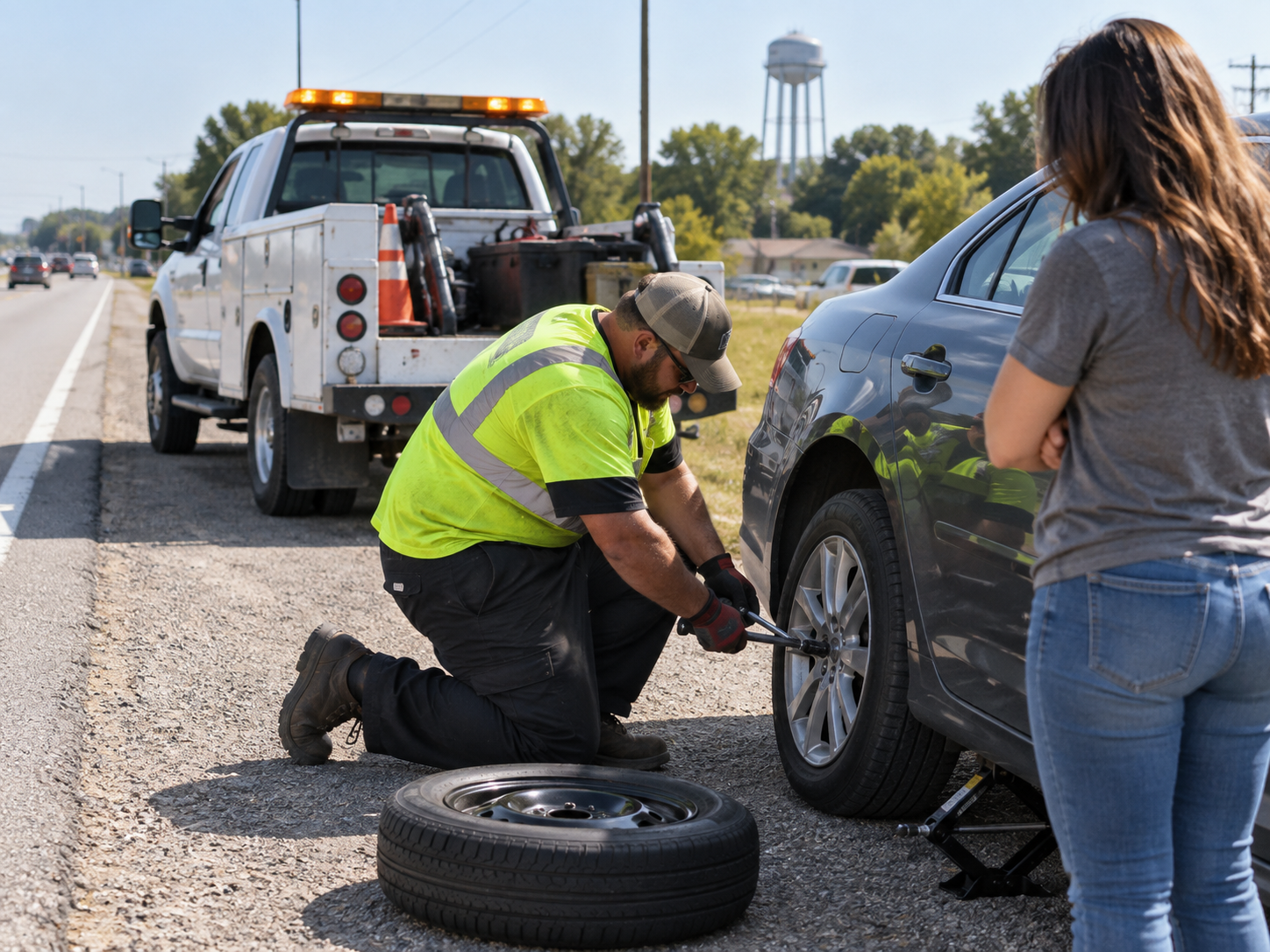
A flat tire can become a bigger repair if the vehicle keeps moving on it. Even a short distance may damage the sidewall, bend the wheel, or put additional stress on suspension components. When possible, pull into a parking area, side street, or another spot away from active traffic before requesting help.
A roadside tire change only works when the conditions make sense. The spare needs to be usable, the wheel itself cannot be badly damaged, and there has to be enough room to safely work around the vehicle. A flat tire in a Bristol shopping center may be relatively simple to handle, while one along Route 6, Route 72, or Route 229 may require a different approach because of traffic and limited shoulder space.
Towing may be the better option when:
- The rim or wheel is bent or damaged
- More than one tire has failed
- There is no usable spare
- Suspension damage is visible or suspected
- The vehicle is stopped somewhere unsafe
- The tire cannot be changed safely where the car sits
If the tire can be replaced on-site, roadside assistance may get you back on the road without needing a tow. If the vehicle still cannot be driven safely afterward, it can be transported to a tire shop, repair facility, dealership, or another destination you choose.
Fuel Delivery for an Empty Tank
Running out of fuel can leave you stuck even when nothing is mechanically wrong with the vehicle. If the car is safely stopped and the only issue is an empty tank, fuel delivery may be enough to get you moving again without arranging a tow.
This can happen on a short trip across Bristol, in a parking lot, or while traveling along Route 6, Route 72, or Route 229. The goal is to bring enough fuel for you to reach a nearby gas station and continue the trip.
If the vehicle still refuses to start after fuel is added, the empty tank may not be the only problem. A battery, ignition, fuel-system, or other mechanical issue could be involved, and towing to a repair facility may be the better next step.
Locked Out of Your Vehicle?
A lockout can happen almost anywhere—outside your home, at work, in a shopping area, or during a stop somewhere around Bristol. Keys may be left inside the car, misplaced, or become inaccessible because of a key-fob or locking-system issue.
Roadside lockout help is intended to restore access without using improvised methods that could damage the glass, weather seals, door hardware, or locking components. Since security systems vary from one vehicle to another, the year, make, and model can be useful information when requesting service.
If a child, pet, or another person is locked inside the vehicle and there is an immediate safety concern, contact emergency services first rather than waiting for routine roadside assistance.
Roadside Help Before Towing Becomes Necessary
A tow is not always the first or best answer. If the problem is limited to a dead battery, flat tire, lockout, or empty fuel tank, roadside assistance may be able to solve it where the vehicle is stopped and save you from arranging transport altogether.
The surroundings play a big role in what can be done safely. A car parked in a Bristol driveway, shopping center, or residential area may leave plenty of room for roadside service. A vehicle stopped along Route 6, Route 72, Route 229, or another busy road may be harder to work around because of traffic, shoulder width, and limited space.
What happens after the first attempt matters too. A successful jump-start or tire change may get the vehicle moving again. If the engine still will not run, the wheel is damaged, the car is overheating, or steering and suspension problems are present, the situation may have moved beyond a simple roadside fix.
The goal is to solve the problem with the simplest service that works safely. When roadside assistance is enough, there is no reason to turn the call into an unnecessary tow.
When Roadside Service Turns Into a Tow
Some problems can be fixed where the vehicle is stopped, but others are signs that the car should not keep moving under its own power. Overheating, steering trouble, damaged wheels, suspension issues, collision damage, or a serious mechanical failure can all make towing the safer choice.
If a jump-start, tire change, fuel delivery, or lockout service does not solve the problem, the next step may be transporting the vehicle to a repair shop, dealership, residence, or another requested destination.
Vehicle condition still matters when choosing the towing setup. A low-clearance car, AWD vehicle, or vehicle with damaged wheels or suspension may be better suited for flatbed transport than a conventional tow.
The main question is simple: can the vehicle continue safely without creating more damage or putting people at risk? If not, towing is usually the more practical option.
Information That Helps Before We Arrive
A few basic details can make it easier to understand what kind of help may be needed before a truck is dispatched.
When you call, it helps to provide:
- Your location
- Vehicle year, make, and model
- What happened before the problem started
- Whether the engine will start
- Whether the vehicle can roll and steer
- Any smoke, leaks, warning lights, or unusual noises
- Whether you have a usable spare if the issue is a flat tire
- Where you want the vehicle taken if towing is needed
If you are stopped along Route 6, Route 72, Route 229, or another busy Bristol road, a nearby intersection, business, or landmark can also help clarify your location.
Need Roadside Assistance in Bristol?
A dead battery, flat tire, empty fuel tank, or lockout does not always mean your vehicle needs to be towed. When the location is safe and the problem is minor, roadside assistance may be enough to get you moving again.
Bristol Towing provides roadside help throughout Bristol for common situations that can often be handled on-site. If the vehicle has a more serious mechanical issue, cannot be driven safely, or does not respond to roadside service, towing can be arranged instead.
When you call, tell us what happened and where the vehicle is located so the next step can be matched to the problem.